
Home / Technology
Our technology
Advanced eye care technology from ZEISS and Essilor
Precise instruments help our optometrists see more, measure more accurately and explain more clearly. Here is the equipment we use, and what it means for you.
At a glance
The instruments behind your eye test
Technology does not replace experience: every result is interpreted by our optometrists, led by chief optometrist Kunal Shah. But the right instruments make each test faster, more accurate and easier to understand.
ZEISS i.Profiler plus
Measures your prescription, how your eye focuses and the shape of your cornea, in one quick scan.
ZEISS VISUPHOR 500 & VISUSCREEN
A digital phoropter and test chart that fine-tune your prescription quickly and precisely.
ZEISS VISUSCOUT 100
A handheld fundus camera that photographs the retina at the back of your eye.
ZEISS slit lamp
A precision microscope for a magnified, detailed look at the health of your eyes.
ZEISS applanation tonometer
Measures the pressure inside your eye, an important check for glaucoma.
Huvitz HLM-7000 lensmeter
A digital lensmeter that reads the exact power of your glasses and checks their UV protection.
Essilor Visioffice 2
Digital measurements of your eyes in your chosen frame, for precisely fitted lenses.
ZEISS
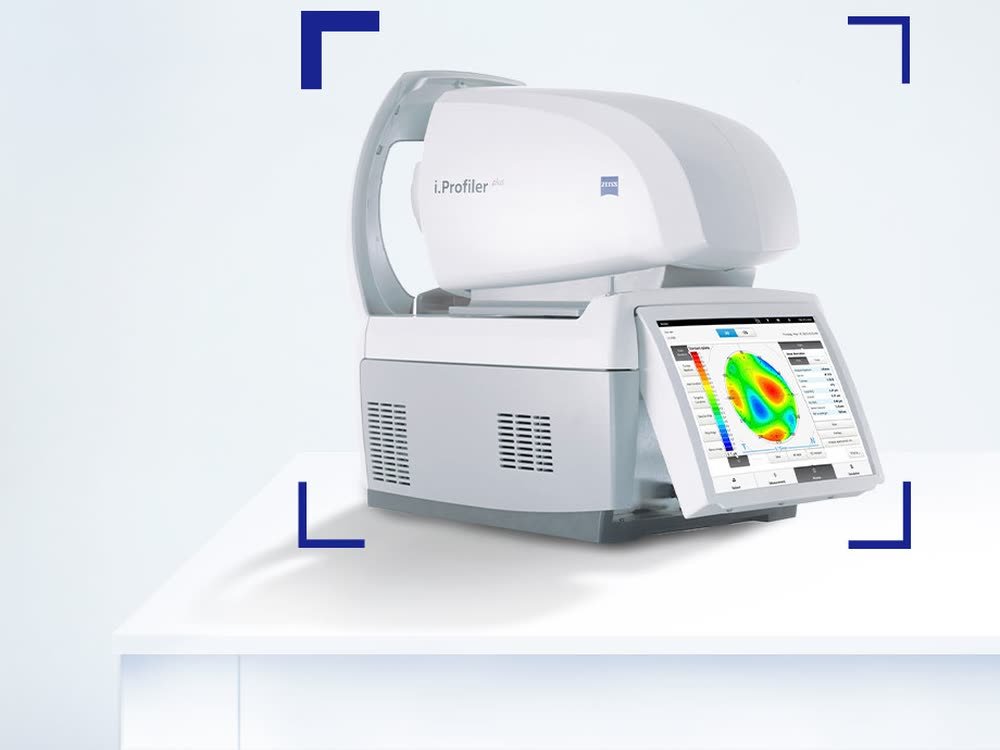
ZEISS i.Profiler plus
The i.Profiler plus combines four instruments in one: a wavefront aberrometer, an autorefractor, a corneal topographer and a keratometer. In a single scan of about a minute it measures your prescription, the shape of the front of your eye, and the tiny optical imperfections that a standard test does not pick up.
How it helps you
- Gives your optometrist an accurate, objective starting point before the subjective test
- Helps explain blurry or glary vision at night, when your pupils are larger
- Maps the shape of your cornea for contact lens and Ortho-K fitting
- Its measurements can be used to order ZEISS lenses with i.Scription technology, personalised to your eyes
Used in: Eye tests · Prescription lenses · Contact lenses · Ortho-K lenses · Myopia management
ZEISS
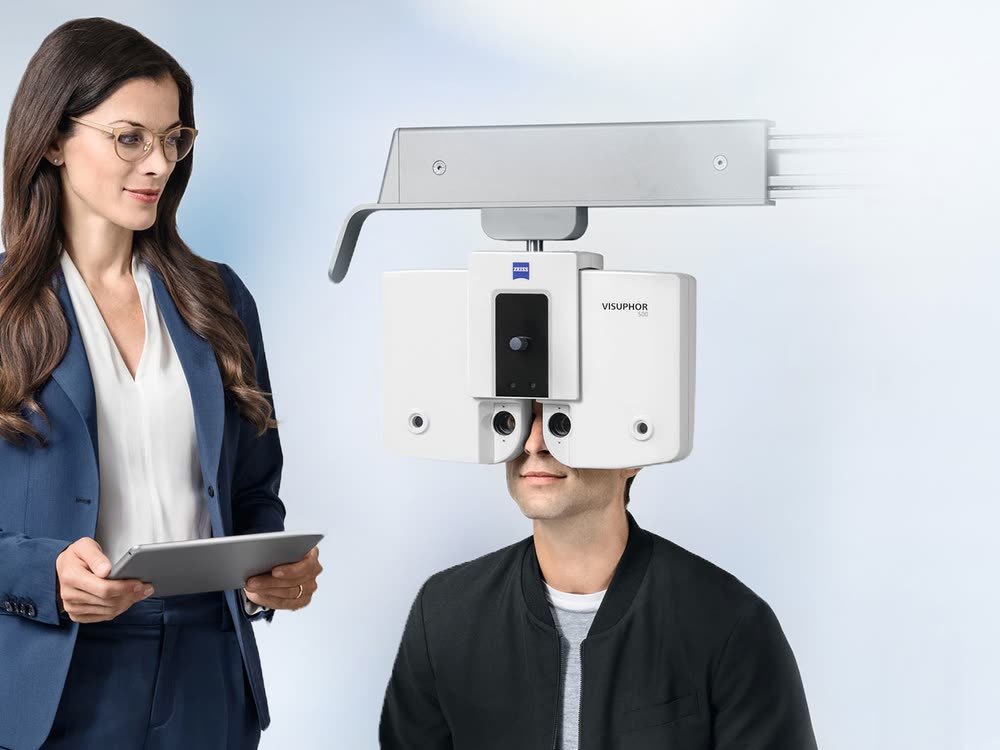
ZEISS VISUPHOR 500 & VISUSCREEN
The VISUPHOR 500 is a digital phoropter: instead of swapping lenses by hand, the optometrist changes them at the touch of a screen. It works together with the VISUSCREEN acuity chart, which offers more than a hundred digital tests, including polarised tests that check how your two eyes work together.
How it helps you
- Fine-tunes your prescription with quick, smooth "which is clearer, one or two?" comparisons
- Checks how your two eyes work together, not just each eye on its own
- Lets us show you the difference between your old and new prescription side by side
- A consistent, comfortable test for children and adults alike
Used in: Eye tests · Prescription lenses · Myopia management
ZEISS
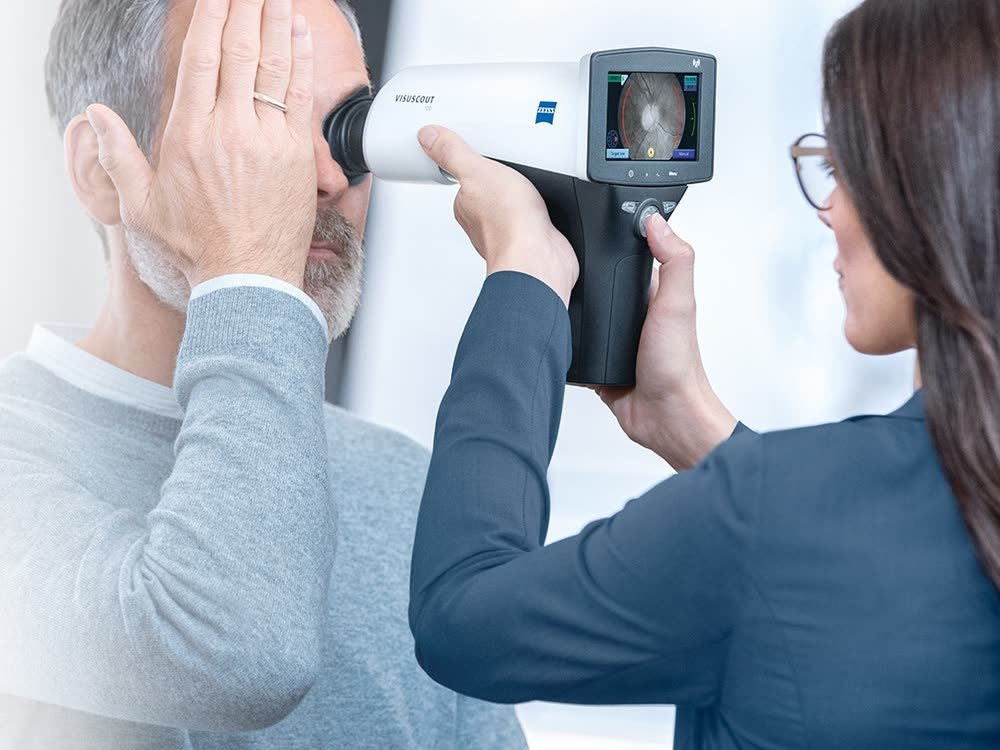
ZEISS VISUSCOUT 100
The VISUSCOUT 100 is a portable digital fundus camera. It takes colour and red-free photographs of your retina, with a 40-degree field of view, and is designed to work without dilating drops in many cases. The images can be stored and compared from one visit to the next.
How it helps you
- Screens for diabetic retinopathy and other retinal changes, often before you notice any symptoms
- Creates a record of your retina to compare at future visits
- Lets us show you what the back of your eye looks like, and explain what we see
- Images can be shared with an eye specialist if a referral is needed
Used in: Diabetic retinopathy screening · Eye tests
ZEISS
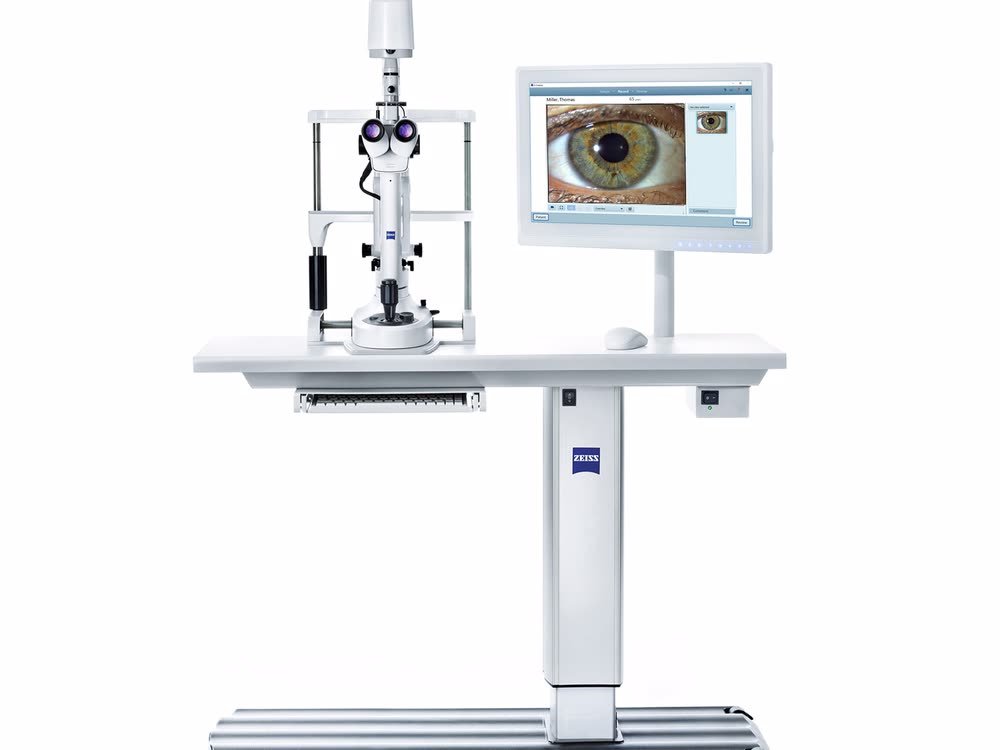
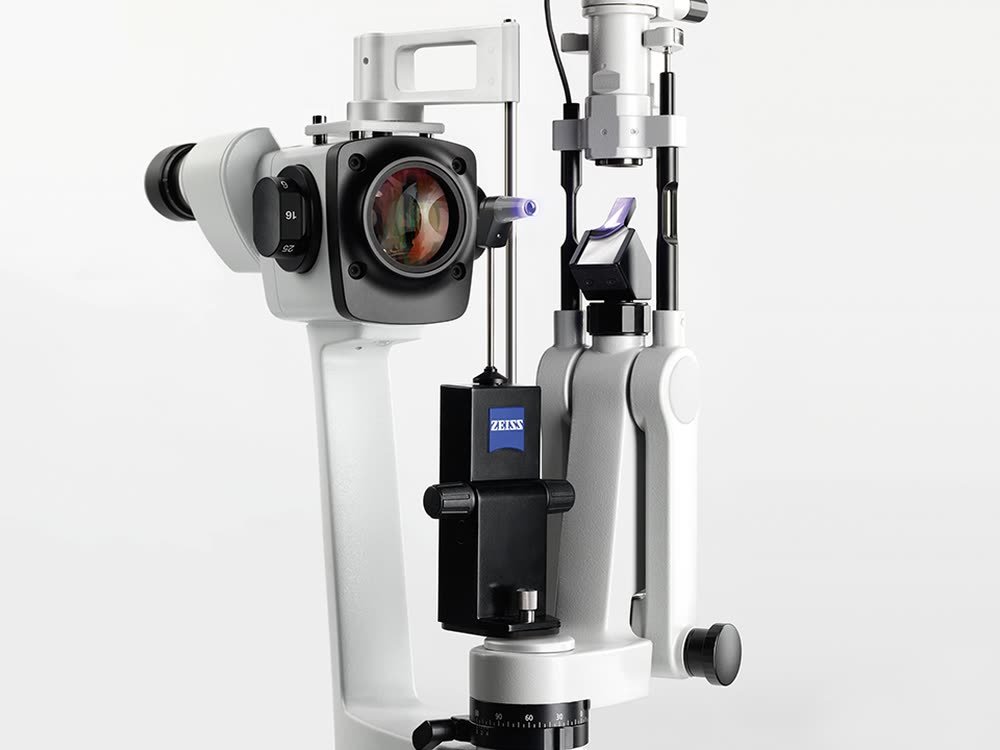
ZEISS slit lamp
The slit lamp is an eye examination microscope with a bright, adjustable beam of light. It gives a magnified, three-dimensional view of your eyelids, cornea, iris and lens, and with an additional lens, the back of the eye too.
How it helps you
- Checks the front of your eye for dryness, inflammation, scratches and early signs of cataract
- Assesses how contact lenses and Ortho-K lenses sit on your eye, and the health of your cornea
- Examines the back of the eye together with other tests
- Works with the applanation tonometer to measure eye pressure
Used in: Eye tests · Contact lenses · Ortho-K lenses · Diabetic retinopathy screening
ZEISS
ZEISS applanation tonometer
The applanation tonometer measures your intraocular pressure, the fluid pressure inside your eye. It works on the Goldmann principle, widely regarded as the reference standard for measuring eye pressure. After a numbing drop, the tip gently touches the surface of the eye for a moment, and the reading is taken.
How it helps you
- Raised eye pressure is a major risk factor for glaucoma, which often has no early symptoms
- Especially useful if you are over 40, or have a family history of glaucoma
- Lets us track your eye pressure over time
Used in: Eye tests
Huvitz
Huvitz HLM-7000 lensmeter
The HLM-7000 is a digital auto lensmeter. Place a pair of glasses on it and it reads the exact power of each lens, including the cylinder, axis, prism and reading addition, and can measure how much ultraviolet (UV) light the lenses let through.
How it helps you
- Reads the prescription in your current glasses, even if you have lost the paper copy
- Checks that your new glasses match your prescription exactly before you collect them
- Measures the UV protection of lenses, including sunglasses
Used in: Prescription lenses · Frame fitting · Sunglasses
Huvitz HLM-7000 lensmeter
Photo of our instrument coming soon.
Essilor Visioffice 2
Photo of our instrument coming soon.
Essilor
Essilor Visioffice 2
Visioffice 2 is a digital measuring system for fitting lenses. While you wear your chosen frame, it measures your pupillary distance, fitting heights, how the frame sits on your face and, in 3D, the rotation centre of each eye: the point your eye turns around as you look in different directions.
How it helps you
- Precise measurements, so the optical centre of each lens lines up with your eyes
- Especially valuable for progressive lenses, where accurate fitting makes them easier to get used to
- Used for personalised Essilor lenses designed with Eyecode technology
Used in: Prescription lenses · Frame fitting · Designer frames
Product images courtesy of ZEISS. Instrument features are as described by their manufacturers; which tests you need depends on your eyes and is decided by your optometrist.